Basic packed slot
Optional static live+preview, or one optional redirect-only live FQDN with one whole-host 307.
Place in standard-n / first free slotCommunity feature proposal
Basic is a tiny fixed envelope with two mutually exclusive uses: reserved optional live + preview static sites, or one optional live FQDN whose complete tree performs one whole-host 307. Intermediate guarantees an expandable reservation. Dedicated is simply that reservation at the profile maximum.
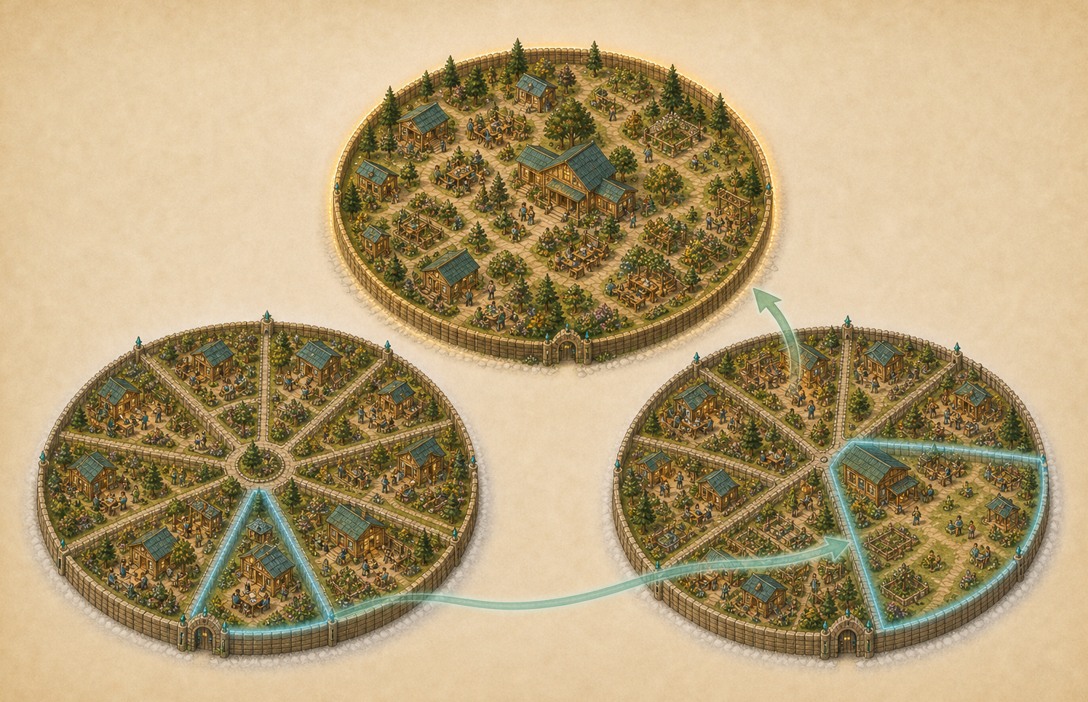
Why this proposal exists
Live plus one optional preview has a fixed shape: the Basic slot reserves two domains and two routes even when preview is not published. Variable requirements can enter an Intermediate shard under a guaranteed Intermediate reservation or take the maximum Dedicated reservation. Every later placement change is a deliberate migration.
Optional static live+preview, or one optional redirect-only live FQDN with one whole-host 307.
Place in standard-n / first free slotExtra hosts and namespaced rules grow inside capacity reserved for this tenant.
Expand in place—or reserve a larger lot before movingOne centered tenant reserves every usable dimension of a separate fixed-size profile.
No later capacity-driven shard moveIs “minimum lot, expandable reservation, or maximum reservation” understandable before onboarding? Share concerns through your usual platform-team channel.
The proposal in one screen
The voting tree later on repeats only the decisions explained here: Basic, Intermediate, Dedicated, explicit migrations, and stable allocation.
One tenant gets one fixed envelope in either content mode (optional static live+preview) or redirect mode (one optional redirect-only live FQDN).
Every tenant begins with the same minimum lot, then can reserve more of the shard’s still-unreserved capacity.
Dedicated is the same reservation model set to every usable dimension of one Standard profile, centered on one tenant with no internal lot boundaries.
Review Dedicated capacity →New Basic tenants take the lowest fully vacant slot. Existing tenants never slide around to compact a shared profile.
standard-n appears only when earlier packs are fullProposed feature: basic

Content mode: live and preview are independently optional. Their two domain/route positions remain reserved even while inactive.
Redirect mode: one optional live FQDN uses one domain/route and one rule set for a single unconditional /* 307 to one validated https:// destination. It has no preview or origin content.
Not Basic: content mixed with redirects, a second redirect FQDN, path-specific/multiple rules, rewrites, headers, cache actions, staging, QA, or a third hostname.
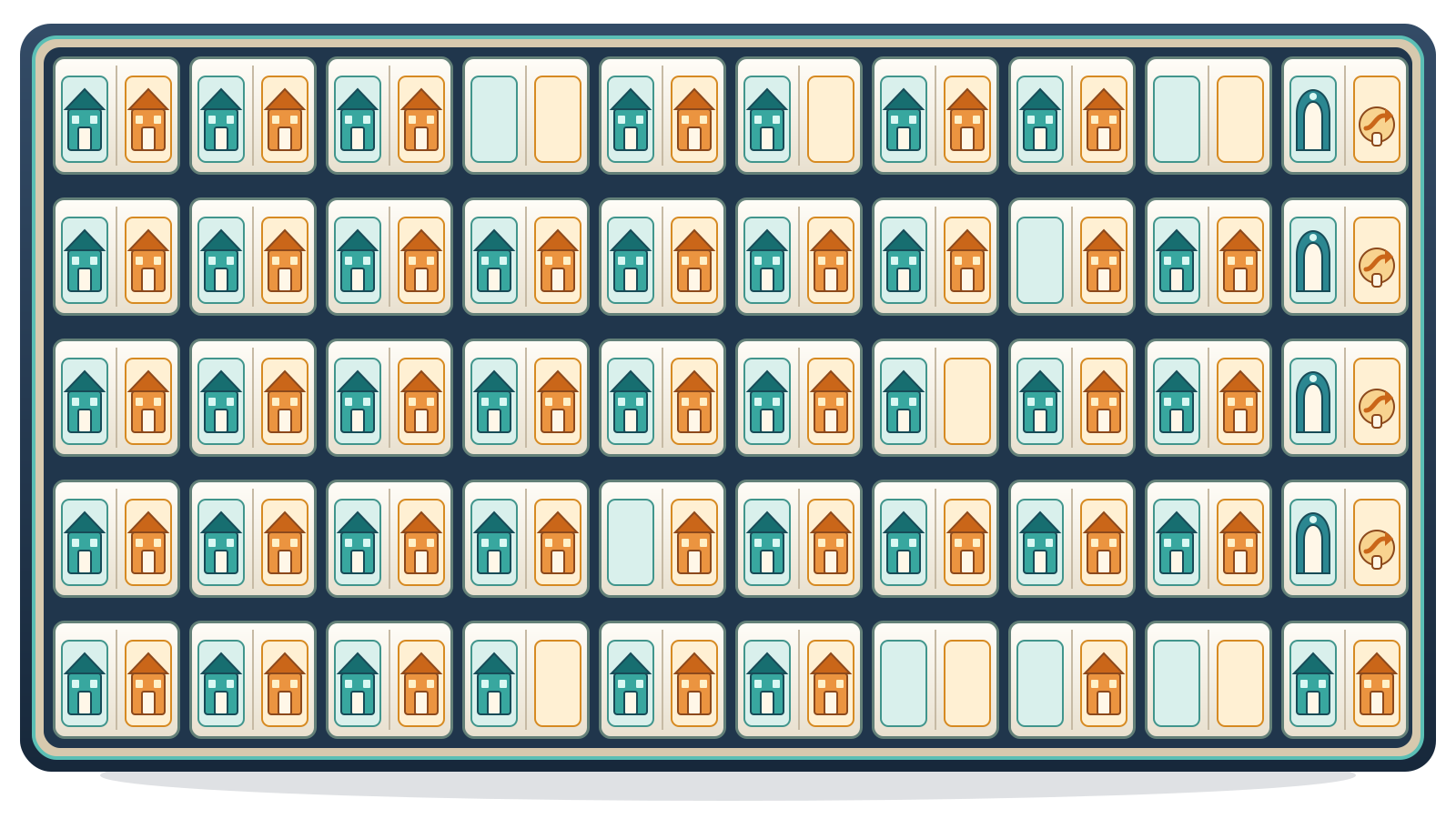
Proposed feature: basic packing
This is specifically a Basic example. Every envelope reserves up to two domain/route positions plus one tenant rule-set position. The same fixed boundary can hold an active static live+preview pair, live-only or preview-only with its counterpart still reserved, or one live FQDN plus the fixed whole-host 307 mechanism. Intermediate does not use these equal envelopes; it uses explicit multidimensional reservations.
Illustrative inventory: 46 envelopes are allocated: 36 publish live+preview, three publish live only, three publish preview only, and four are redirect-only. Four complete envelopes remain vacant. That is 82 active routes plus 10 reserved-but-inactive domain/route positions, so the allocator has committed 92 of 100. Only the four redirect envelopes deploy their reserved tenant rule set.
Stable allocation
Proposed feature: intermediate
Every Intermediate shard is the same fixed-size Front Door Standard profile. Tenants begin with the same minimum Basic envelope, then may reserve wider multidimensional lots from unreserved capacity. A reservation never shrinks unless the tenant chooses a smaller plan. Being a good neighbor means not warehousing a large unused lot: that empty fence cannot be sold to anyone else, so it reduces the packing efficiency of the whole shard instance.
The reservation covers routes, domains, rule sets, composite route complexity, and enabled policy associations. It is not one misleading “rules” number.
Do not hold a large unused reservation “just in case.” Tenant chargeback is lot size plus utilities, so extra fenced room is billed even while empty. That unused fence also cannot be resold, which lowers packing efficiency for everyone else on the shard.
If the current shard has enough unreserved vector capacity, the lot expands atomically in place. Otherwise the complete larger lot is held on a sparser/new shard before preview-first verification (when present) and scheduled-live migration.
Dedicated is not an oversized shard. Its pictured lot has the same total area as one complete Intermediate shard, with one tenant holding all usable capacity—the only option that avoids every future capacity-driven shard move.
Tenant chargeback is lot rent priced from the reservation vector (current use plus extra reserved) plus metered utilities for traffic, requests, stored bytes, and storage operations. Releasing unused fence returns capacity to the shard and lowers that tenant’s lot rent because the lot got smaller. A future bill must reconcile hostname/project telemetry to the actual Azure invoice rather than present estimates as exact tenant charges.
Proposed feature: dedicated
Intermediate and Dedicated are one reservation continuum. Intermediate holds a fenced, guaranteed lot inside a shared fixed-size shard. Dedicated places one tenant on an identical profile and reserves its complete usable capacity vector after platform-owned capacity. The Azure limits and service contract do not become larger; only the internal co-tenant boundaries disappear.
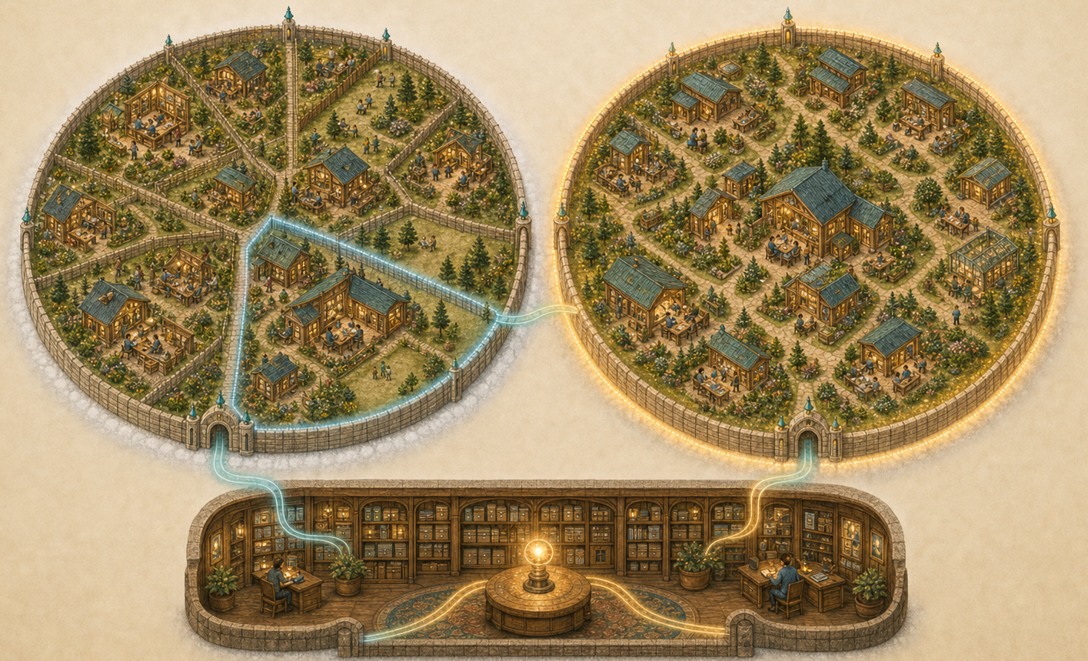
Domains, routes, rule sets, composite route complexity, and policy associations remain the dimensions. The reservation reaches each usable profile limit rather than inventing a larger tier.
Live, preview, staging, QA, experiments, and namespaced rules may occupy the one reservation as admitted. There is no neighboring tenant allocation inside it.
A neighbor can no longer block an expansion, so Dedicated is the only placement that cannot require another move solely to obtain a larger reservation.
Dedicated chargeback is a maximum-size lot rent plus the same metered utilities. Requests, transfer, stored bytes, and storage operations remain separately measured.
The maximum lot is a destination size, not a shortcut. The platform still recreates the current service unchanged, transfers the exclusive hostname, and keeps the source reservation through soak. Only after that sequence may the tenant use its additional room.
Proposed feature: explicit growth
A tenant moves because its current lot cannot hold the
requested reservation. The destination lot is larger, but migration does
not change behavior: every currently valid domain, route, rule
association, cache policy, origin path, and environment moves as one
service inventory. The new feature that triggered growth remains pending
until that same service is stable on the target. Repository,
PROJECT_ID, uploader identity, and blobs stay where they are.
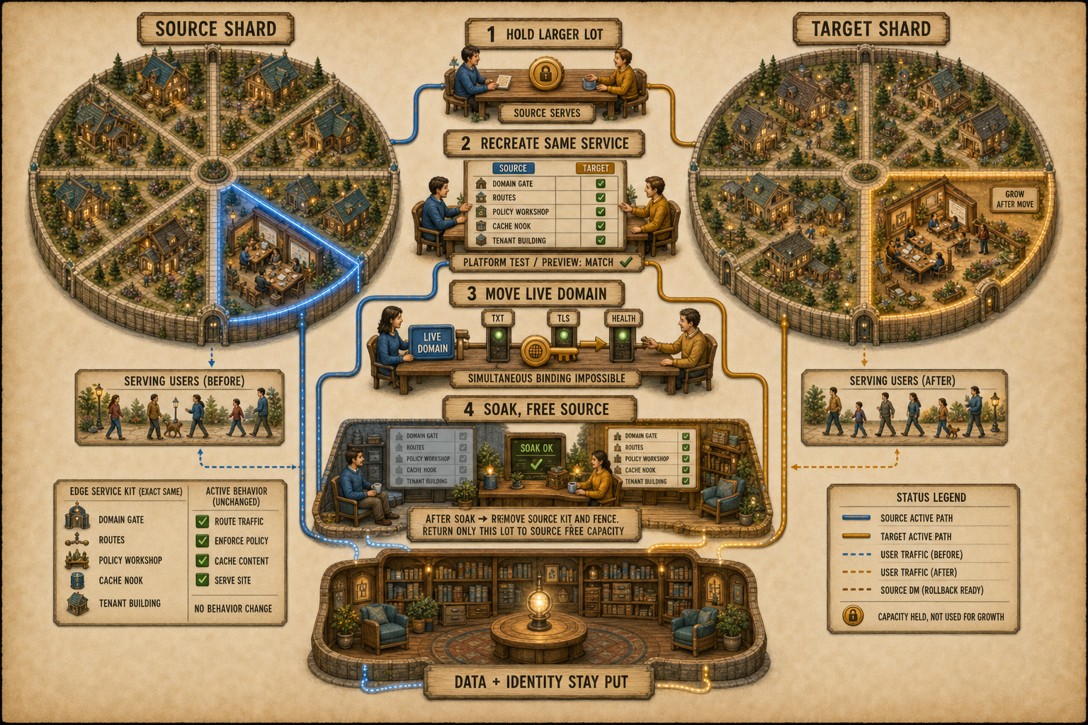
Capacity gate
Serialize allocation, reserve the complete target vector, retain the source reservation, inventory every active edge object, and capture a source-health baseline.
Nothing changes. The source shard keeps serving the last valid configuration; the requested growth remains inactive.
Capacity must be guaranteed before touching service. It prevents a half-built move and avoids displacing target-shard neighbors.
Target reservation is durably held, source and target generations agree, and the complete migration inventory is frozen.
Equivalence gate
Recreate origins, routes, rule associations, cache behavior, and environments against the same immutable storage paths. Test through a platform hostname and transfer preview first when one exists.
Production still uses source. Owners compare target status, bodies, redirects, headers, and cache behavior; preview may undergo its own non-production handoff.
Separating placement from feature change makes failures diagnosable. The target must prove it serves the same site before receiving live traffic.
Automated comparisons pass, route health is green, and the customer accepts the unchanged target behavior.
Exclusive hostname gate
Offer evidence-backed quiet windows when exact-host logs are representative; otherwise use a clearly labeled manual window. The customer confirms, and DNS TTL cools for at least one old TTL before cutover.
Source serves until release. During the unique-domain, TXT, certificate, route, and DNS handoff, requests may be interrupted; managed-certificate deployment can take minutes to an hour or longer.
Front Door cannot bind the same custom domain to both profiles. Target-specific TXT proof and managed TLS cannot be completed before target-domain creation.
The public FQDN has valid TLS, returns the expected body or Location through target, reports healthy routing, and appears in target access logs.
Rollback gate
Keep the low TTL and complete source reservation while monitoring public responses, TLS, route health, logs, deploys, and purges. Rollback is a full reverse ownership and certificate handoff—not a CNAME flip.
Traffic uses target with unchanged behavior. The growth request remains pending until the soak is accepted; failures trigger the documented reverse handoff.
The intact source lot is rollback insurance. Freeing it early would remove the known service inventory before target behavior is established.
Customer and platform accept the observed soak, normal TTL is restored, source edge objects are retired, its reservation is freed, and only then may the target use its empty growth room.
Unsupported additions leave the last valid service running. The platform allocator performs the unchanged move; the newly admitted capability applies afterward inside the larger reservation.
Proposed feature: custom rules

One redirect today can become a match tree tomorrow. We do not want to promise “five redirects,” watch the file grow, then reshuffle neighboring sites.
Basic supports only one platform-shaped rule: the unconditional whole-host 307 in its redirect-only mode. Intermediate applies path-specific, mixed-content, or other namespaced rules inside its guaranteed vector; a larger change first expands that reservation or offers a pre-reserved move. Dedicated sets the same vector to the profile maximum.
Redirects remain temporary HTTP 307, evaluated before cache and origin. Azure’s per-profile, per-rule-set, per-route, condition/action, and effective-rule accounting still applies.
One reservation, several environment routes
Intermediate and Dedicated may give live, preview, staging, QA, and other test hosts their own routes. Rule sets may be shared across those routes or scoped to one environment; each route still obeys Azure’s associated-rule ceiling. The platform validates the complete reservation before apply.
Examples and limits follow Microsoft’s current match conditions, rule actions, and Front Door Standard service limits. Cache-enabling route overrides can consume extra effective rule capacity.
Simply put
Conditions can identify an environment hostname, path, extension, query string, header, cookie, method, protocol, client location, IP range, or device type. A tenant may declare a requested rule; platform identity validates and applies the namespaced configuration from a reviewed action set.
Match: /old-guides/*
Action: send the browser to /guides/*, preserving the request rather than proxying it.
Match: an application route such as /app/*
Action: request a different origin path while the visitor keeps the original URL.
Match: one environment or content type
Action: add, replace, or remove approved headers—for example security or CORS response headers.
Match: /status.json, an extension, or selected query parameters
Action: bypass cache, honor origin, set a different TTL, or control query-string caching.
Proposal tree
Each collapsible branch below restates one of the three summaries above. The branches start expanded so every proposed item remains visible, but you can collapse them while comparing priorities. Every item uses the same wording as its detailed section and links back to that context. The scores are illustrative—not community results—and your vote changes only this browser tab.
Choose Basic, an expandable Intermediate reservation, or the maximum Dedicated reservation, then use an explicit verified migration whenever placement changes.
A tiny predictable slice supports a static pair or one whole-host redirect.
Reserve two static domain/route positions even while either is inactive.
Each safely reserves up to two domains/routes and one tenant rule set.
One unconditional whole-host 307 uses the complete Basic mode; custom rules remain Intermediate.
Reserve an expandable lot on a fixed shard, or reserve the maximum usable capacity for one tenant.
Probe target, rehearse preview when present, schedule live, verify and soak, then free source.
Intermediate grows them inside its reservation; Dedicated holds the maximum profile budget.
Path and host redirects before origin, with source-tree cache purge.
Reviewed, namespaced rules use an Intermediate reservation or the maximum Dedicated reservation.
The dedicated profile’s service limits are the product ceiling, not an arbitrary platform quota.
Placement is infrastructure state, serialized and fail closed.
Reuse complete holes; do not compact occupied slots.
A destroyed slot becomes the next tenant’s slot without reshuffling.
One lock prevents two new tenants from choosing the same vacancy.
Proposed feature: self-service control plane
A registry can make placement easy to query, but serialized Infrastructure-as-Code remains the allocator of record. It maps immutable PROJECT_ID to Basic slot, Intermediate shard, or Dedicated profile plus the exact host and route inventory. A generation mismatch between desired state, registry, and Azure fails closed.
Tenant workflows upload only beneath their project prefix. A trusted platform operation resolves the current edge placement for purge and verification; repositories do not receive arbitrary Front Door authority.
With explicit installation permissions, an App can propose the standard workflow, set repository variables or encrypted secrets, and ask the backend to provision GitHub OIDC trust. Installation grants repository access—not Azure or DNS authority.
Platform-managed zones can automate aliases, CNAMEs, and TXT proof. External DNS needs customer action or a separately authorized provider integration. Apex names use provider alias/flattening support; they are not ordinary CNAMEs.
A platform-owned prj-<id> name can hide shard endpoints, but it does not remove the Front Door custom-domain transfer. Direct visitor CNAME to *.azurefd.net remains the simplest managed-certificate path.
Request for comments
Are optional static live+preview and one redirect-only live FQDN the right fixed, inexpensive choices?
Is “your reservation never shrinks unless you release it; chargeback is lot size plus utilities; a good neighbor does not warehouse unused capacity” clear?
Which redirects and safe match/action rules would you actually request?
When is avoiding every future capacity-driven move worth reserving a complete Dedicated profile?
What proof and soak should be required before traffic leaves any source shard and its allocation is freed?
What failure or teardown case should the slot allocator plan for?
Which lot-size chargeback rates and metered traffic/storage breakdowns would make costs understandable and auditable?
This preview is the discussion starter. Vote on the topics that feel useful, then share the “why,” missing branches, and counterexamples through your usual platform-team channel. The illustrative scores are not collected feedback.